




Calorie Tracking for Food Delivery in Holon: A Practical Guide
Introduction
In Holon's business districts, from the industrial zone to the office centers, ordering lunch or a snack during a busy workday is almost the default. The problem starts when you try to record that order in a calorie-tracking log, because unlike a meal prepared at home, there is no real way to know exactly what went into the dish.
This gap doesn't mean you need to give up the convenience of delivery. It does mean changing how you document deliveries—and deciding which parts of the order deserve precise tracking and which can reasonably be estimated.
Two Completely Different Categories in Every Order
Every delivery order essentially consists of two types of items that require very different approaches:
Item Type | Examples | Possible Accuracy |
|---|---|---|
Prepared restaurant meal | Prepared salad, sandwich, pasta dish | Estimate only; depends on preparation |
Packaged product added to the order | Protein bar, yogurt, beverage, snack | Full accuracy; directly from the manufacturer's label |
The most common mistake is treating the entire order as a single “block” and estimating everything together. In reality, part of the order can be tracked with complete accuracy, while only the prepared meal requires an estimate.
Examples from Typical Orders in the Business District
To illustrate the difference, here's what a typical office lunch order might look like:
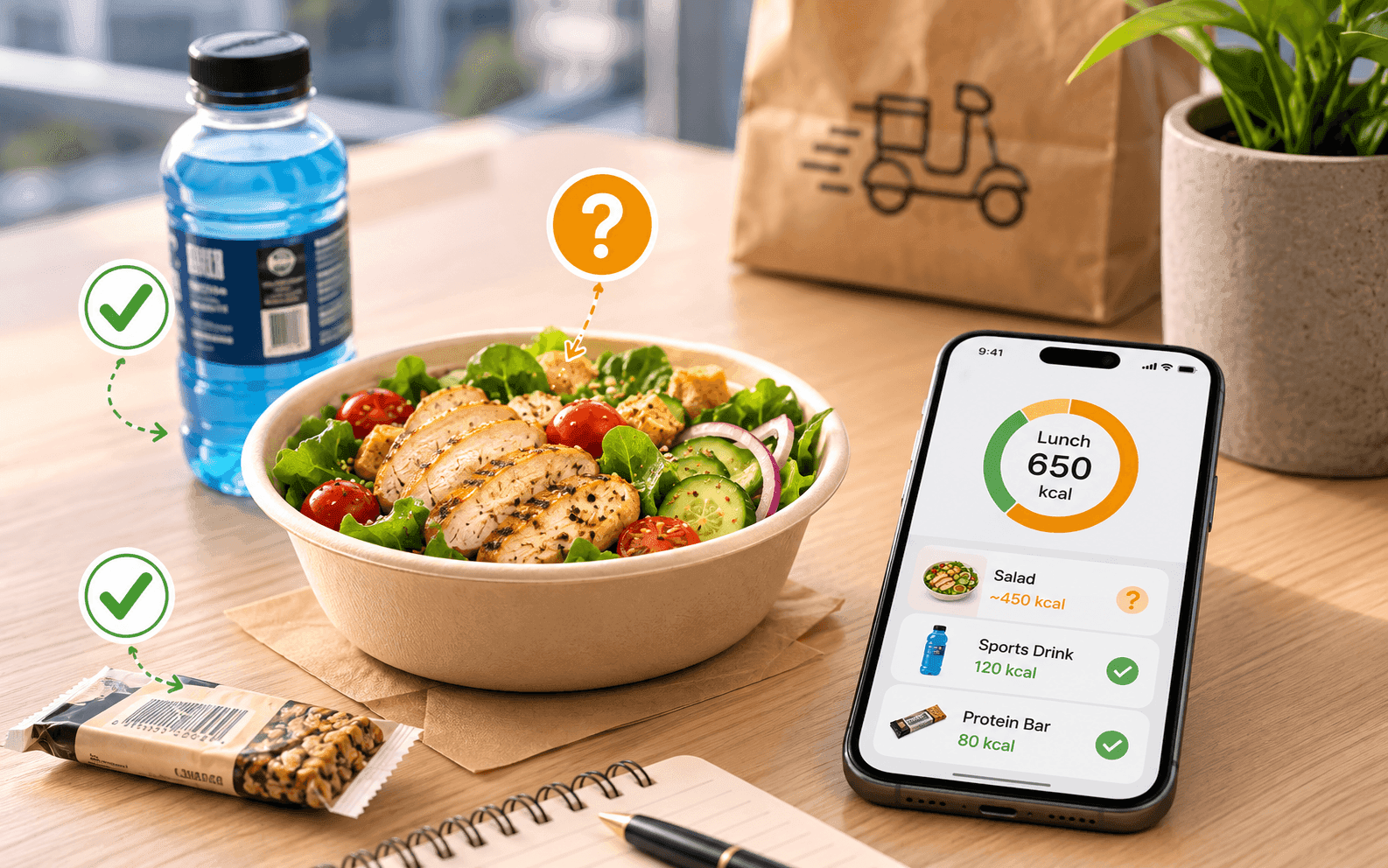
Example order: A chicken salad from a restaurant, along with a protein bar and a sports drink ordered from a store through the same app.
- The salad: Requires an estimate because you don't know exactly how much dressing, oil, or toppings were added.
- The protein bar: Can be recorded with complete accuracy simply by scanning its barcode.
- The sports drink: The same applies—the nutritional information can be taken directly from the product label without any estimation.
Within a single order, two-thirds of the items can be tracked completely accurately, even if the remaining third still requires an estimate.
Three Questions to Ask Before Adding an Item to Your Food Log
Instead of using a complicated process, three simple questions can help you decide how to document each item:
1. Does this item have a barcode?
If so, scan it. There's no reason to estimate something whose nutritional information can be obtained accurately within seconds.
2. Does the prepared meal come with nutritional information from the restaurant?
Some restaurants do publish estimated nutritional values. If so, this is a better starting point than estimating from scratch.
3. Can the meal be customized when ordering?
Requesting dressing on the side or choosing a specific portion size can improve your control even before the order arrives.
Why Snacks and Beverages Especially Require Consistent Scanning
When you order the same protein bar or beverage almost every day, it's easy to assume you already know exactly how many calories it contains. But differences in flavor, package size, or accidentally switching to a “light” version can significantly change the nutritional information.
Consistent barcode scanning—even for “familiar” products—helps ensure:
- You don't confuse two similar versions of the same product.
- New flavors or varieties aren't added to your food log without verification.
- If the product's ingredients or nutritional composition change, your recorded information can be updated accordingly.
What This Looks Like in Everyday Life
A habit that is established correctly at the beginning stays simple over time:
- Place your order normally through your preferred delivery app.
- When the order arrives, separate packaged products from the prepared meal.
- Scan the barcode of every packaged product before adding it to your food log.
- Record the prepared meal using a reasonable estimate based on its portion size and visible toppings.
Within a week or two, this process can become automatic and require very little additional thought with each new order.
Conclusion
Ordering delivery in Holon's business districts doesn't have to turn calorie tracking into a guessing game. Separating what can be known precisely—packaged products with barcodes—from what must remain a reasonable estimate—prepared restaurant meals—allows you to maintain a high level of tracking accuracy without giving up the convenience of ordering during a busy workday.