




Calorie Tracking in Kiryat Gat: How Delivery and Grocery Orders Can Improve Accuracy
Introduction
In major cities in central Israel, a delivery app can display dozens of boutique restaurants with specialized menus. In Kiryat Gat, the reality is different: there is a smaller selection, more chains and franchise restaurants, and fewer unique options. From a calorie-tracking perspective, this is not necessarily a disadvantage—it simply requires a different approach.
This article does not ignore that reality. Instead, it shows how the more limited selection, with a stronger emphasis on chains and packaged products, can actually make calorie tracking simpler rather than more complicated, if you know how to take advantage of it.
The Hidden Advantage of Fewer Boutique Options: More Chains With Publicly Available Data
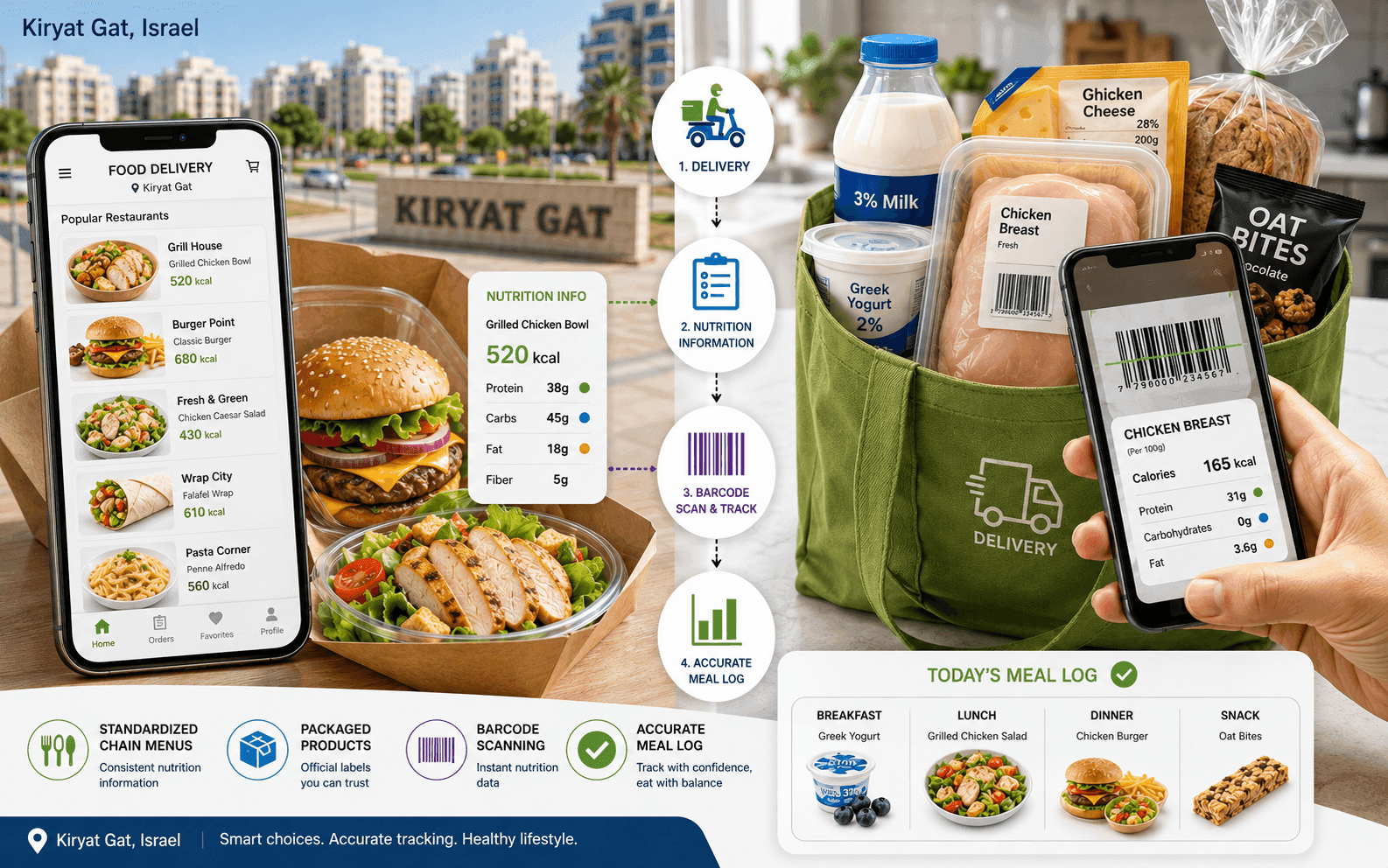
While a small boutique restaurant often does not publish nutritional information, large chains and franchise restaurants—which are more common among delivery options in cities such as Kiryat Gat—frequently publish complete calorie information on their websites or apps.
In practice, this means that in a city with fewer “unique” options, you may actually be more likely to find:
- Official calorie information provided by the chain itself rather than a general estimate
- Standardized menus across different branches, making the information more consistent over time
- Customized options explicitly presented by the chain, such as “light” menus or lower-calorie versions
The Other Side: Grocery and Convenience-Store Deliveries as a Main Resource
In a relatively small city, grocery and convenience-store deliveries can account for a larger share of total deliveries compared with larger cities, where restaurant deliveries tend to dominate. From an accuracy standpoint, this can actually be beneficial, because packaged products typically come with a barcode and precise nutritional information.
This advantage is especially noticeable when ordering:
- Dairy products and cheeses for home-prepared meals assembled from the delivery
- Packaged snacks and baked goods added to the grocery order
- Packaged meat and chicken with the weight and nutritional information printed directly on the packaging
How Barcode Scanning Becomes Central to Tracking Grocery-Based Deliveries
When most of a delivery consists of grocery products rather than a prepared meal, barcode scanning becomes more than a helpful tool—it becomes a central part of documenting the entire meal, not just one component.
Here is how it works in practice:
- The order arrives with mostly packaged products rather than one prepared meal.
- Each product is scanned by barcode before being placed in the refrigerator or cupboard.
- The meal prepared from those products is recorded based on the exact ingredients rather than a general estimate of a “home-cooked meal.”
Unlike a restaurant order, where part of the meal will almost always require an estimate, an entire grocery order can be documented with near-complete accuracy, item by item.
What to Do When You Order From a Well-Known Chain
When you do feel like ordering from a restaurant rather than a grocery store, it is worth taking advantage of the benefits that large chains offer:
- Check the chain's website or app before ordering. Most major chains publish a complete calorie table.
- Match your order to the available information. For example, choose the lighter version of a dish if one is listed on the menu.
- Save the information for next time. A meal that has been accurately documented once does not need to be estimated again the next time you order it.
Summary
Living in a city like Kiryat Gat, with a more limited delivery selection than major central Israeli cities, does not necessarily mean less accurate calorie tracking. On the contrary, the stronger presence of chains with publicly available nutritional information, combined with grocery deliveries where every product has a barcode, can make tracking more accurate than ordering from a boutique restaurant that does not publish any nutritional information.