


How Accurate Are AI Calorie Counting Apps?
Introduction
If you've ever pointed your phone camera at a plate of food and watched an app spit out a calorie count in seconds, you've probably wondered: is that number actually right, or is it just a confident guess?
It's a fair question. AI calorie counting apps have gone from a novelty to a daily habit for millions of people trying to lose weight, build muscle, or simply understand what they're eating. But accuracy is where trust is either earned or lost.
This article gives you a straight answer: how these apps actually work, where they get it right, where they still struggle, and what you can do to get numbers you can rely on.
How AI Calorie Tracking Actually Works
Behind the scenes, an AI calorie counting app isn't "guessing" the way a human might eyeball a plate. It typically combines a few technologies:
- Image recognition to identify what food is in the photo
- Portion estimation using visual reference points in the image
- A nutrition database that matches recognized food to known calorie and macro values
- Machine learning refinement, where the model improves its estimates over time based on corrections and large volumes of food data
The strength of this system comes from the size and quality of its food database and how well its portion estimation has been trained. The more diverse and detailed that data, the closer the estimate gets to reality.
Where AI Calorie Apps Get It Right
For most common, clearly visible foods, AI-based tracking is genuinely reliable, often close enough that the difference doesn't matter for real-world results.
Areas where these apps perform well:
- Packaged and branded foods: barcode scanning pulls exact manufacturer data, leaving almost no room for error
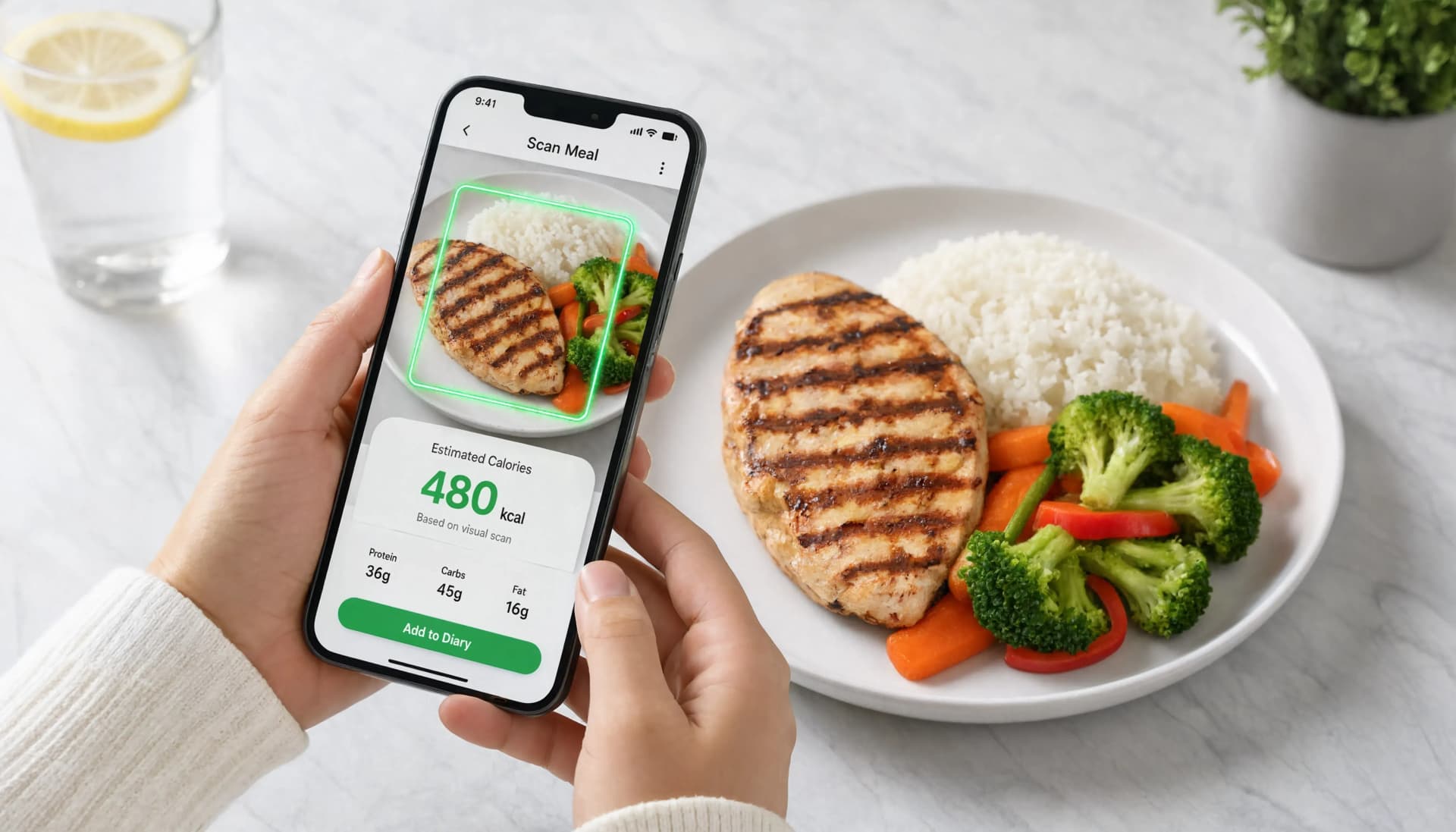
- Single, clearly visible items: a whole fruit, a plated piece of grilled chicken, or a bowl of rice photographed from a clear angle
- Common home-cooked meals: dishes the AI has seen thousands of times across its training data
- Consistency over time: even if one estimate is slightly off, tracking the same way every day still reveals accurate trends in your eating patterns
For someone using a tool like a photo-based calorie counter, this covers the vast majority of everyday meals.
Where AI Still Struggles
No AI system is flawless, and it's worth being upfront about the situations where accuracy naturally drops.
- Mixed dishes with hidden ingredients: a curry, casserole, or stir-fry can hide oil, butter, or sugar that isn't visible in a photo
- Unusual angles or poor lighting: the AI relies on what it can see, so an obscured or badly lit photo weakens the estimate
- Homemade recipes with no standard reference: grandma's recipe with three secret ingredients won't match any database entry exactly
- Extremely small or overlapping portions: garnishes, sauces, or foods stacked together are harder to separate visually
- Restaurant meals with inconsistent recipes: the same dish name can mean very different calorie counts from one restaurant to another
In these situations, an AI estimate is usually a reasonable ballpark, not a lab-grade measurement. That's an important distinction to understand rather than something to hide from.
AI vs. Manual Logging: Which Is Actually More Accurate?
It's easy to assume manual entry is more precise because a person is "being careful." In practice, the opposite is often true.
Method | Common Error Source | Real-World Accuracy |
|---|---|---|
Manual guessing | Portion size misjudged by eye | Often off by 20 to 50 percent |
Manual database search | Wrong food match, outdated entries | Moderate, depends on user effort |
AI photo/barcode scan | Hidden ingredients, poor lighting | Generally within a smaller, more consistent margin |
The key advantage of AI tracking isn't perfection, it's consistency. A tool that removes guesswork and human bias tends to produce more reliable long-term data than someone manually estimating portions from memory.
How to Get More Accurate Results From an AI Calorie App
Accuracy isn't only about the technology, how you use it matters just as much.
A few habits that meaningfully improve results:
- Photograph food from a clear, top-down angle with good lighting whenever possible
- Scan barcodes for packaged items instead of relying on a photo estimate
- Log ingredients separately for homemade mixed dishes, rather than photographing the finished plate as one item
- Correct estimates when you know better, since many AI tools use that feedback to refine future accuracy
- Use consistent tracking daily, since long-term patterns matter more than any single meal's exact number
An AI calorie tracker that combines photo scanning, barcode recognition, and voice logging gives you multiple ways to log accurately depending on the food in front of you.
Does Small Inaccuracy Actually Matter?
Here's the part most articles skip: perfect accuracy isn't actually required for results.
Weight loss and muscle gain respond to consistent trends over weeks and months, not the precision of a single meal. If an app is off by 5 to 10 percent on a mixed dish but you track that way consistently every day, your overall calorie picture still stays close enough to guide real decisions.
The goal isn't a flawless number. It's a number accurate enough to build awareness, spot patterns, and adjust intake with confidence, which is exactly what modern AI tracking delivers for the vast majority of everyday eating.
Conclusion
AI calorie counting apps aren't perfect, and any tool claiming otherwise isn't being fully honest. But when it comes to everyday foods, packaged products, and consistent daily tracking, they're significantly more reliable than manual guessing, and they get better the more thoughtfully they're used.
The real question isn't "is this number exact," it's "is this number useful." For most people trying to understand and manage their eating, the answer is a clear yes.