


How accurate are AI apps that count calories from photos?
Introduction
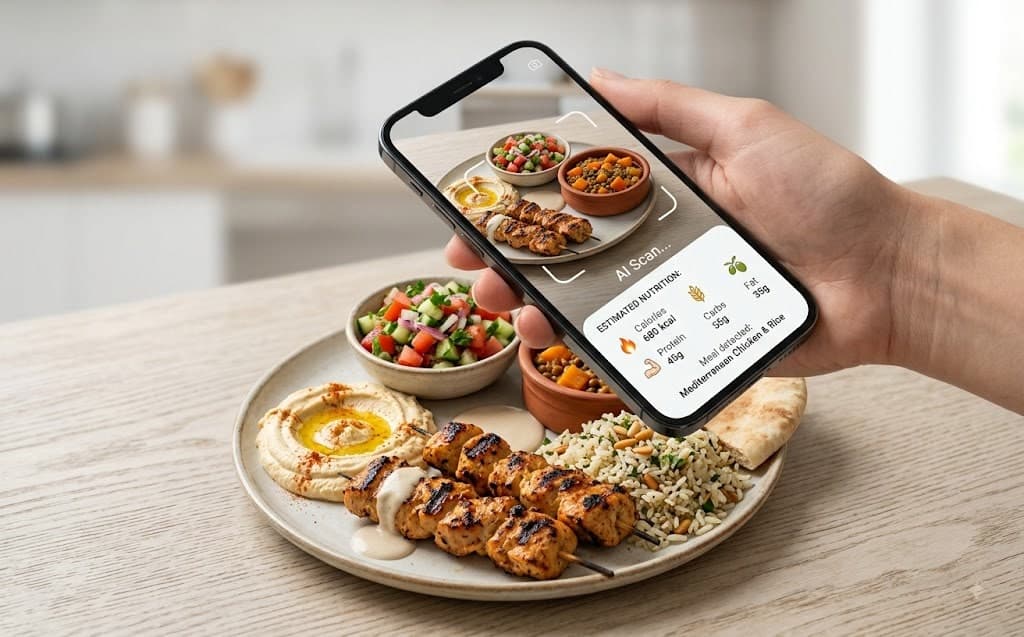
Taking a photo of a plate of food and getting a complete calorie breakdown within seconds sounds almost magical, but the question most people quietly ask is: Is that number actually accurate, or is it just a convincing guess?
It's a legitimate question, especially when it comes to Israeli cuisine, such as mixed stews or dishes containing lots of oil and sauces, which are harder to estimate than a simple serving of grilled chicken breast and vegetables. This article gives you a straightforward answer: how the technology actually works, where it's accurate, where it's less accurate, and how to get the most reliable results from it.
How Does an AI App Actually Identify Food?
Behind the scenes, the app isn't making a random guess. It uses several layers of technology together:
- Image recognition that identifies which ingredients are on the plate
- Portion-size estimation based on visual reference points in the image
- Nutritional databases that match each identified ingredient with calorie and nutritional values
- Machine learning that improves over time as the system receives more corrections and images
The larger and more diverse the database, the closer the estimate is likely to be to reality.
Where Is the App Especially Accurate?
For foods that are clear and visible, accuracy is generally quite high, sometimes close enough that the difference doesn't meaningfully affect the outcome.
- Packaged products with barcodes, where scanning provides accurate data directly from the manufacturer
- A single clearly visible food, such as a whole piece of fruit or grilled chicken breast on a simple plate
- Common homemade dishes that the system has encountered many times in its database
- Consistency over time — even if an individual estimate is slightly inaccurate, consistent daily tracking can still reveal reliable trends in eating habits
Where Does It Still Struggle?
No AI system is perfect, and it's important to be honest about situations where accuracy naturally decreases.
- Dishes with hidden ingredients, such as cholent, thick soups, or stews containing large amounts of oil that aren't visible in the image
- Poor lighting or unclear angles, which make it harder for the system to clearly identify what's on the plate
- Unique homemade recipes without an exact match in the database
- Meals with lots of sauces and toppings, such as a plate containing hummus, tahini, and salad, where it's difficult to visually separate the ingredients
- Restaurant dishes with inconsistent recipes, where the same dish can contain very different amounts of oil depending on the restaurant
In these situations, an AI estimate is generally a reasonable range, not a laboratory measurement. That's an important distinction to understand, not something to hide.
AI vs. Manual Tracking: Which Is Actually More Accurate?
It's easy to assume that manual tracking is more accurate because "a person is paying attention," but in practice, the opposite often happens.
Method | Common Source of Error | Actual Accuracy |
|---|---|---|
Visual estimation | Incorrect portion-size estimation | Often a 20–50% deviation |
Manual database search | Incorrect match or outdated information | Varies depending on user effort |
AI photo or barcode scanning | Hidden ingredients, poor lighting | Generally smaller and more consistent deviations |
The main advantage of AI-based tracking isn't perfection—it's consistency. A tool that removes guesswork and personal bias tends to produce more reliable data over time than manually estimating from memory.
How to Get More Accurate Results
Accuracy doesn't depend only on the technology; it also depends on how you use it.
A few habits can significantly improve the results:
- Take a clear photo from above, with as much good lighting as possible.
- Scan barcodes for packaged products instead of relying on image estimation.
- Record ingredients separately for mixed homemade dishes, rather than photographing the finished plate as one single meal.
- Correct estimates when you know the actual amount, since many tools can learn from these corrections to improve future results.
- Track consistently every day, because the long-term trend matters more than the exact number for a single meal.
Does a Small Inaccuracy Really Matter?
This is the part most articles skip: perfect accuracy isn't actually necessary to see results.
Weight loss or muscle gain responds to consistent trends over weeks and months, not the precision of a single meal. If an app is off by 5–10% on a mixed dish, but you track consistently every day, the overall calorie picture can still be accurate enough to make meaningful decisions.
The goal isn't a perfect number. The goal is a number that's accurate enough to build awareness, identify patterns, and adjust your diet with confidence. That's exactly what AI-based tracking can provide for most everyday eating.
Conclusion
AI-powered calorie-counting apps aren't perfect, and any claim otherwise simply isn't honest. But when it comes to everyday foods, packaged products, and consistent tracking, they can be much more reliable than manual estimation, and they can improve as you use them more thoughtfully.
The real question isn't "Is the number completely accurate?" but rather "Is the number useful?" For most people who want to understand and manage their eating habits, the answer is clearly yes.
If you want to test it for yourself, try a calorie-tracking app and see how easy it is to start recording meals accurately and consistently.