




Macro Split For Weight Loss: How To Set Yours
Introduction
Calories decide whether the scale moves. Macros decide whether you can actually stick around long enough to see it happen.
Two people eating the exact same 1800 calories a day can have completely different experiences, one constantly hungry and drained, the other satisfied and energized, purely based on how those calories are split between protein, carbs, and fat. That split is what's known as a macro ratio, and getting it right is often the difference between a diet that lasts and one that quietly falls apart by week three.
This guide covers how to actually set a macro split for weight loss, the common ratios people use, and how to pick one that fits your body and your routine instead of copying whatever ratio a stranger online swears by.
What "Macros" Actually Means
Macronutrients are the three categories that make up virtually everything you eat:
- Protein: 4 calories per gram, used for muscle repair, satiety, and structural tissue
- Carbohydrates: 4 calories per gram, the body's primary and fastest energy source
- Fat: 9 calories per gram, essential for hormone production and long-term energy
A macro split is simply the percentage of your total daily calories that comes from each of these three categories. Set the total calories first, then decide how that number gets divided.
Why the Split Matters Even When Total Calories Stay the Same
It's tempting to think that as long as total calories are correct, the ratio between them doesn't matter much. In practice, the split affects several things that determine whether a deficit actually feels sustainable.
- Hunger control: protein and fiber-rich carbs tend to keep you fuller for longer than an equal number of calories from refined carbs or added sugar
- Energy for training: carbohydrates fuel higher-intensity workouts more efficiently than fat does
- Muscle preservation: protein intake directly affects how much lean tissue is protected during a deficit
- Long-term adherence: a split that leaves you constantly craving foods you've cut out is much harder to maintain than one built around foods you actually enjoy
The same calorie total can feel completely different depending on how it's divided, which is exactly why macro splits deserve attention beyond just hitting a calorie number.
Common Macro Splits for Weight Loss
There's no single "correct" ratio, but a few approaches are widely used, each with a different focus.
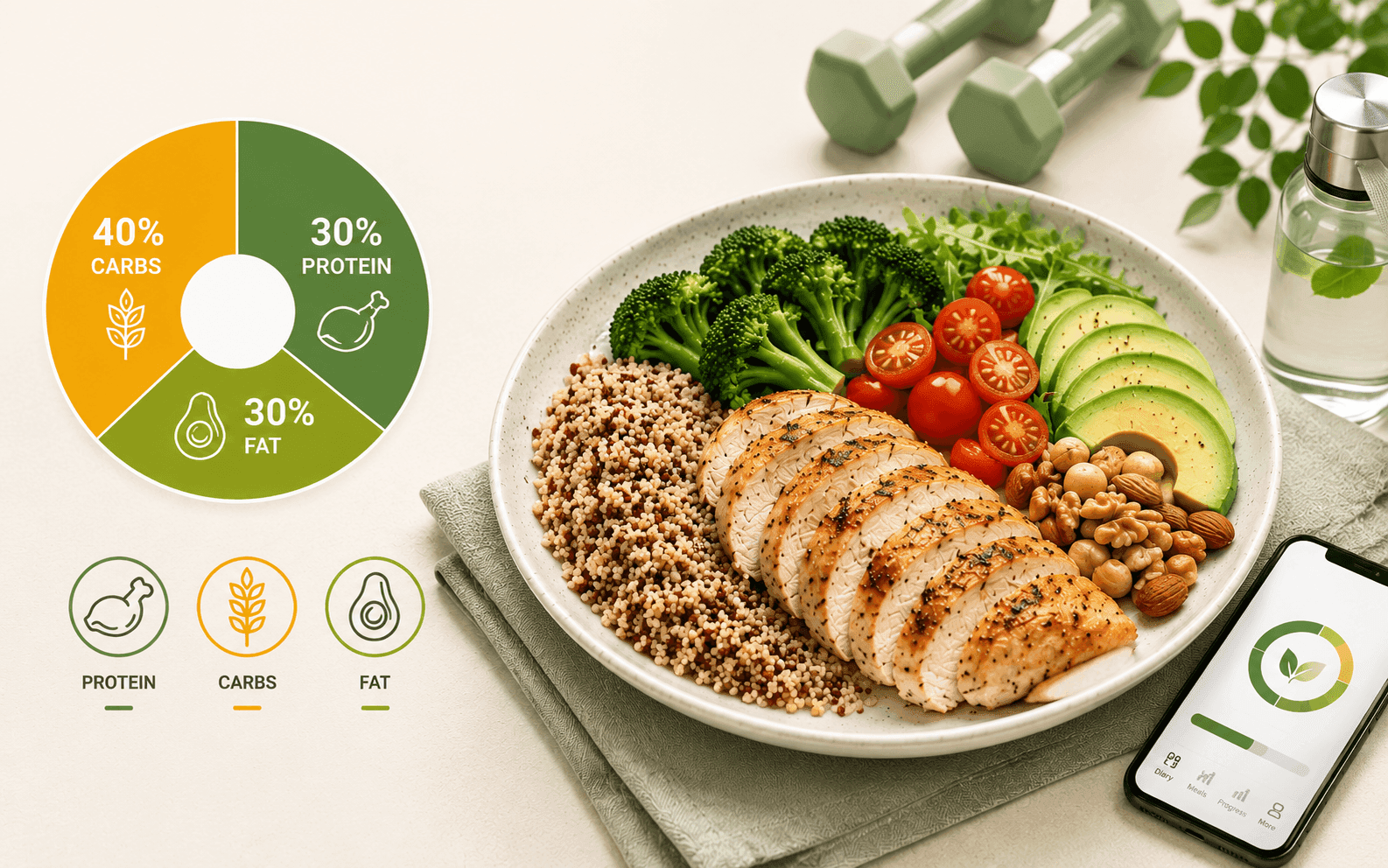
Balanced split (roughly 40% carbs / 30% protein / 30% fat) A moderate approach that works well for most people, providing enough carbs for training energy while keeping protein high enough to protect muscle.
Higher-protein split (roughly 40% protein / 35% carbs / 25% fat) Prioritizes muscle preservation and hunger control, often preferred by people doing regular strength training during their deficit.
Lower-carb split (roughly 25% carbs / 35% protein / 40% fat) Reduces carbohydrate intake in favor of fat, which some people find helps manage hunger and blood sugar swings, though it can limit performance in high-intensity training.
Higher-carb, active-lifestyle split (roughly 50% carbs / 30% protein / 20% fat) Suited to people with high daily activity or frequent intense training, where carbohydrate availability directly affects performance and recovery.
None of these are universally "best." Each trades off differently between hunger management, training performance, and food preference, which is why the right choice depends on the person, not the ratio itself.
How to Calculate Your Macro Split From Your Calorie Target
Once you know your daily calorie target for weight loss, turning a percentage split into grams takes three steps.
Example: 1800 calories a day, using a balanced 40/30/30 split
- Protein: 30% of 1800 = 540 calories ÷ 4 calories per gram = 135 grams
- Carbohydrates: 40% of 1800 = 720 calories ÷ 4 calories per gram = 180 grams
- Fat: 30% of 1800 = 540 calories ÷ 9 calories per gram = 60 grams
The same math applies to any calorie target and any split, just change the percentages and recalculate. Doing this by hand is straightforward once you know the steps, but a macro calculator does the conversion instantly and adjusts automatically if your calorie target changes.
Choosing the Right Split for Your Situation
Rather than picking a ratio because it's popular, work backward from your actual routine.
- If you strength train regularly: lean toward a higher-protein split to protect muscle during the deficit
- If you do frequent cardio or endurance training: a higher-carb split supports performance and recovery better
- If you struggle with hunger throughout the day: a higher-protein, moderate-fat split tends to improve satiety
- If you prefer fewer, larger meals: a split with more fat can help meals feel more satisfying, since fat digests more slowly
- If you have no strong training demands: a balanced split is a safe, flexible starting point
The best split is one you can follow consistently for months, not the one that looks most impressive on paper.
Adjusting Your Split Over Time
A macro split isn't locked in permanently. As your training, schedule, or hunger patterns change, the ratio can shift with them.
Signs it might be time to adjust:
- Persistent hunger despite hitting your calorie target, often solved by increasing protein
- Low energy during workouts, often solved by increasing carbs around training days
- Feeling unsatisfied after meals despite eating enough volume, sometimes solved by increasing fat slightly
- Difficulty hitting protein consistently, which may mean simplifying the split rather than adding more targets to track
Small adjustments over time tend to work better than switching to a completely different ratio every few weeks.
Conclusion
Total calories set the direction of weight loss, but the macro split decides how the process actually feels day to day, how hungry you are, how your workouts go, and how long you're able to stick with the plan. There's no single perfect ratio, only one that matches your training, your appetite, and your food preferences closely enough to follow consistently.
Set your calorie target first, then use the macro calculator to turn a percentage split into exact grams you can build meals around.